
Introduction#
One of the oldest arguments in cybersecurity is probably:
“Security Through Obscurity is not real security.”
And honestly, I understand why many security people dislike that phrase so much. Why just change port number from 80 to 8080 or 65080 does not have any useful like setting to not expose web server or CMS name and versions?
Because if a system is fundamentally vulnerable, simply hiding the version number or changing the default port will not magically save it from compromise. A determined attacker will eventually fingerprint the service anyway.
But after working with real systems for years, I also think many people oversimplify this discussion too much, even make it like a vulnerability that need to be solved, even its solution is really not practical and so risky.
Because in reality, attackers are lazy too.
And reducing unnecessary information exposure absolutely can reduce attack surface, automated exploitation, noise from scanners, and opportunistic attacks — as long as we stay realistic and do not turn operational hardening into self-inflicted suffering.
That balance is the important part.
Why Version Disclosure Matters#
A huge amount of modern offensive security work starts with fingerprinting.
Attackers scan:
- server banners
- framework headers
- CMS versions
- API responses
- SSH banners
- TLS fingerprints
- favicon hashes
- default error pages
because the moment they identify a product and version, they immediately start correlating:
- CVEs
- exploit PoCs
- Metasploit modules
- public GitHub exploits
- Shodan results
- automated scanners
Sometimes people underestimate how much attackers automate this process now.
An exposed version string like:
Apache/2.4.49or:
OpenSSH 7.2p2 Ubuntubasically becomes free reconnaissance data.
The attacker no longer needs to guess what stack exists underneath. The system starts introducing itself voluntarily.
And unfortunately, many real-world attacks are not sophisticated APT magic at all. They are just internet-wide automation searching for known vulnerable versions that somebody forgot to patch.
Obscurity Is Not Useless. It Is Just Not Enough Alone.#
This is where the discussion usually becomes emotionally weird online.
Some people act like hiding versions is completely useless.
Others behave like changing SSH port from 22 to 2222 somehow transforms their server into Fort Knox.
Reality is somewhere in between.
Security through obscurity should never be treated as the primary security control. But reducing unnecessary information disclosure is still reasonable hardening in many situations.
Especially against:
- automated scanners
- internet background noise
- opportunistic attackers
- low-effort exploit spraying
- mass internet scanning bots
The key word is:
layered defense.
If removing version disclosure costs almost nothing operationally, then honestly why expose it publicly?
The Dangerous Part Is When Hardening Becomes Operational Pain#
This is where I started changing my perspective over time.
I once experimented with aggressively hiding OpenSSL/OpenSSH version information from scans like Nmap. At first it sounded like a fun hardening exercise.
Then reality arrived.
To fully suppress or alter certain version fingerprints properly, I ended up touching package source code, rebuilding packages through dpkg, recompiling components, and modifying behavior deeper than normal configuration intended.
And honestly?
It quickly became operational hell.
Because the moment you start heavily modifying packaged software:
- updates become painful
- patch management becomes dangerous
- maintenance becomes annoying
- future upgrades become unpredictable
- troubleshooting becomes harder
- package integrity assumptions break
Suddenly a simple:
apt update && apt upgradestarts feeling slightly terrifying because you are no longer running normal upstream packages consistently.
And for what exactly?
To hide version strings from Nmap slightly better?
At some point the hardening effort itself becomes riskier than the original information disclosure problem.
That is the line many people forget to evaluate.
Practical Hardening Usually Wins#
This is why nowadays I prefer practical hardening over obsessive hardening.
For example, in OpenSSH on Debian systems, simply setting:
DebianBanner noinside:
/etc/ssh/sshd_configalready removes unnecessary Debian version disclosure from SSH banners.
That is practical.
Low operational risk. Easy maintenance. Still compatible with normal updates. Still supported behavior.
And honestly, for most real-world environments, that level of reduction is already enough.
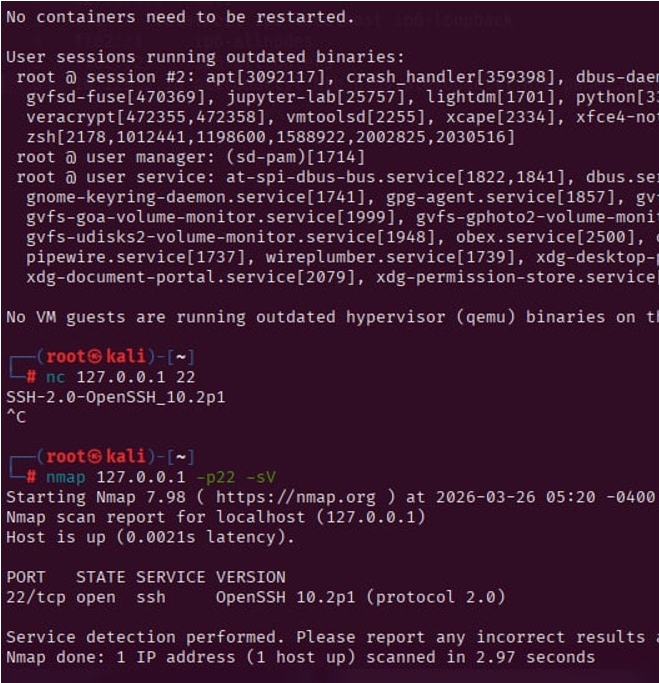
And even if you dare to edit the OpenSSL package and recompile successfully, it will go back to default version exposed after “abnormal long long time apt upgrade” again as shown in the picture:
The same mindset applies elsewhere too.
Removing:
- framework version headers
- verbose error pages
- unnecessary banners
- default CMS metadata
- excessive server tokens
is usually reasonable.
But rebuilding half your infrastructure from modified source code just to win against Nmap banner detection becomes much harder to justify operationally.
Attackers Fingerprint More Than You Think Anyway#
Another important reality is that modern attackers fingerprint systems using many signals simultaneously.
Even if you hide:
Apache/2.4.xthey may still infer technology through:
- TLS behavior
- response headers
- favicon hashes
- JavaScript files
- HTTP behavior
- cookie patterns
- API responses
- default routes
- CDN behavior
- WAF fingerprints
Completely hiding infrastructure identity is often much harder than people initially expect.
That does not mean hardening is pointless.
It simply means:
obscurity reduces information leakage, but should never replace actual patching, segmentation, monitoring, and secure architecture.
Security Is Always About Tradeoffs#
This is something many newer security people slowly learn with experience.
The “most hardened” configuration is not always the best configuration.
Sometimes the best security decision is the one that:
- reduces meaningful risk
- remains maintainable
- survives patch cycles
- does not destroy operations
- does not confuse future administrators
Security engineering is not only about making attackers suffer.
It is also about not accidentally making defenders suffer more than attackers.
And honestly, many infrastructure disasters begin when systems become so overengineered that nobody wants to touch them anymore.
Final Thoughts#
I still believe reducing unnecessary information disclosure is good practice.
Exposing exact framework versions, CMS versions, SSH banners, or verbose server fingerprints publicly rarely provides meaningful benefit to defenders. Meanwhile attackers happily consume that information for reconnaissance and automated targeting.
But I also think security people should be careful not to turn hardening into operational self-harm.
If hiding a banner takes one clean configuration line, great.
If hiding a version requires rebuilding packages manually every update cycle while risking infrastructure stability, maybe it is time to ask whether the tradeoff still makes sense.
Because in real-world security, practicality matters too.
And sometimes the strongest hardening decision is knowing where to stop.
#Sarah59 #ThaiCySec